Cutting tools used in machining processes are among the most critical factors that directly affect production quality and operation speed. A cutting tool's rapid wear or breakage not only increases tool costs; it also extends production times, reducing company efficiency. Therefore, for manufacturing companies, correct management of cutting tool performance is of much greater critical importance than anticipated.
The tool technologies used in modern production processes are actually quite advanced. However, improper use, unsuitable cutting parameters, or inadequate machine conditions can seriously reduce tool life. Especially in sectors where mass production is performed, tool durability has a strategic role in terms of cost control.
As tool change frequency increases in production processes, company costs also rise. Therefore, for companies, cutting tool life is not only a technical matter but also an economic production criterion. Low tool life can lead to these problems:
Deterioration of part surface quality
Decreased dimensional precision
Increased machine downtime
Higher tool costs
Production scheduling disruptions
Extended machining time
Of course, to achieve sustainable quality in production, tool performance must first be continuously monitored. Especially in productions requiring high precision, even small deformations can directly affect product quality.
Systems operating with correct parameters achieve economical tool life. This approach prevents premature tool replacement while also preventing quality losses that may occur from excessive use.
It should be understood that many different factors affect the service life of cutting tools. Incorrect cutting values, high temperature, vibration, and unsuitable tool selection are foremost among these problems. Especially in high-speed machining processes, even small errors can cause serious tool damage.
Incorrect Cutting Speed and Feed Selection
One of the most important factors directly affecting cutting tool performance is machining parameters. Unsuitable cutting speed and speed settings can cause rapid tool wear. Using excessively high speed creates excessive temperature at the tool tip while low speed results in inefficient cutting.
Incorrect feed amount determination also causes uneven load on the tool surface. This increases cutting forces making the tool difficult to operate stably. Especially when machining hard materials, using incorrect parameters can create serious performance losses.
Cutting tool wear resulting from incorrect processing values causes deformation of tool geometry and decreased surface quality. If wear progresses, the tool becomes completely unusable.
Excessive Heat and Incorrect Cooling Methods
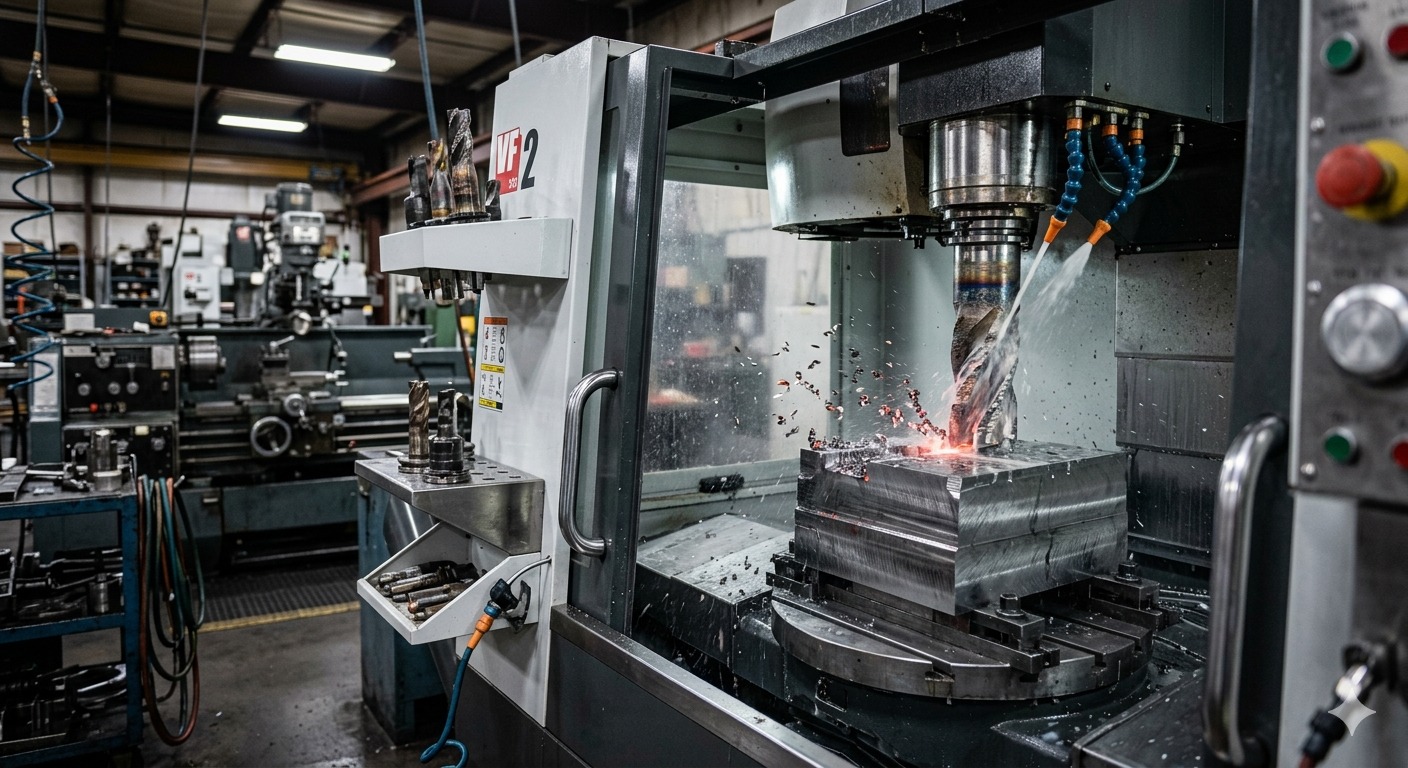
The high temperature generated during the cutting process can cause serious deformations on the tool surface. Especially in high-speed CNC operations, if an appropriate cooling system is not used, tool durability decreases rapidly. Incorrect cooling methods cause these problems:
Crack formation on the cutting edge surface
Coating deformation
Precision loss due to thermal expansion
Chip evacuation becomes difficult
Tool hardness decreases
Temperature control is especially important in carbide tools. Because high temperature directly creates negative effects on carbide tip life. Applying cooling fluid at the correct pressure and appropriate angle can significantly increase tool performance. Additionally, in some cases, incorrect cooling use creates thermal shock effect. This can lead to micro-crack formation at the tool tip.
Breakage from Machine Vibration
One of the important causes of tool breakage is vibration generated during machining. Insufficient machine frame rigidity or improper workpiece fastening can cause vibration during cutting. Inadequate machine rigidity prevents the tool from operating stably and causes uneven distribution of cutting forces. This especially increases breakage risk in small-diameter tools.
We can give these examples of problems that may occur due to vibration:
Micro-crack formation at the tool tip
Surface quality deterioration
Decreased dimensional precision
Sudden tool breakage during cutting
Extended machining time
Among the causes of many tool breakages seen in production processes, vibration-related problems occupy an important place. Machine stability becomes critical especially in high-speed operations.
We must note that using quality tools alone is not sufficient to improve cutting tool performance. Certainly quality is important but correct machining strategies must also be applied. Machining parameters, tool selection, and machine condition should be evaluated together. Look at the methods that can be applied to extend tool life immediately.
Selecting the appropriate tool for the workpiece
Determining correct cutting parameters
Performing regular tool inspection
Using high-quality cooling systems
Preferring fastening methods that reduce vibration
Using appropriate tool coatings
Not neglecting CNC maintenance processes
Optimizing chip evacuation
Through correct strategies, the goal of extending cutting tool life becomes more sustainable. Especially for companies performing mass production, even small improvements in tool performance can provide significant cost advantages.
In modern manufacturing understanding, achieving high industrial tool life not only reduces tool costs; it also contributes to maintaining quality standards. Efficient tool use is also critical in terms of overall machining efficiency. Shortened production times and reduced downtime increase companies' competitive power.
As Kahraman Kalıp, we have a manufacturing understanding based on high quality standards in precision production processes. Through our modern CNC machining infrastructure and engineering-focused production approach, we provide professional solutions for different sectors.
Thanks to advanced machining technologies we use in production processes, tool performance is optimized and high-precision manufacturing is targeted. Through correct machining strategies, quality tool use, and regular process control, production efficiency is increased.
We continue our work rapidly with a sustainable quality understanding in die manufacturing and machining processes. We will continue to provide customers with long-life and high-precision manufacturing solutions.