In sheet metal forming processes, a factor equally important as the die is press selection. No matter how correctly a die is designed, if an unsuitable press is used, production quality and equipment lifespan can be negatively affected. For this reason, press capacity, working characteristics, and tonnage values are among the fundamental parts of production planning. Especially in businesses engaged in series production, correct equipment choices reduce costs while supporting quality continuity.

Press selection is much more than determining machine capacity. Because this is a decision that directly affects production speed, energy consumption, maintenance costs, and product quality.
If a press's capacity falls short of requirements, the production process experiences strain. Using an excessively large press can increase energy and investment costs. Therefore, correct press and tonnage selection suited to the production process's needs should be made.
When an appropriate press is used, cycle times become more stable. Dies operate more controllably and unplanned stoppages are reduced. This directly creates a positive impact on production efficiency.
When selecting a press, not only the tonnage value but also technical details such as stroke length, working speed, table dimensions, and eccentric design should be evaluated. Because two different presses with the same tonnage value can yield different results in the same application.
Especially for businesses engaged in high-volume production, correct equipment investment can provide returns in a short time. Lower maintenance costs and more stable production processes create competitive advantage.
Each die type operates on a different principle. Therefore, the press's characteristics should also be determined according to the production scenario.
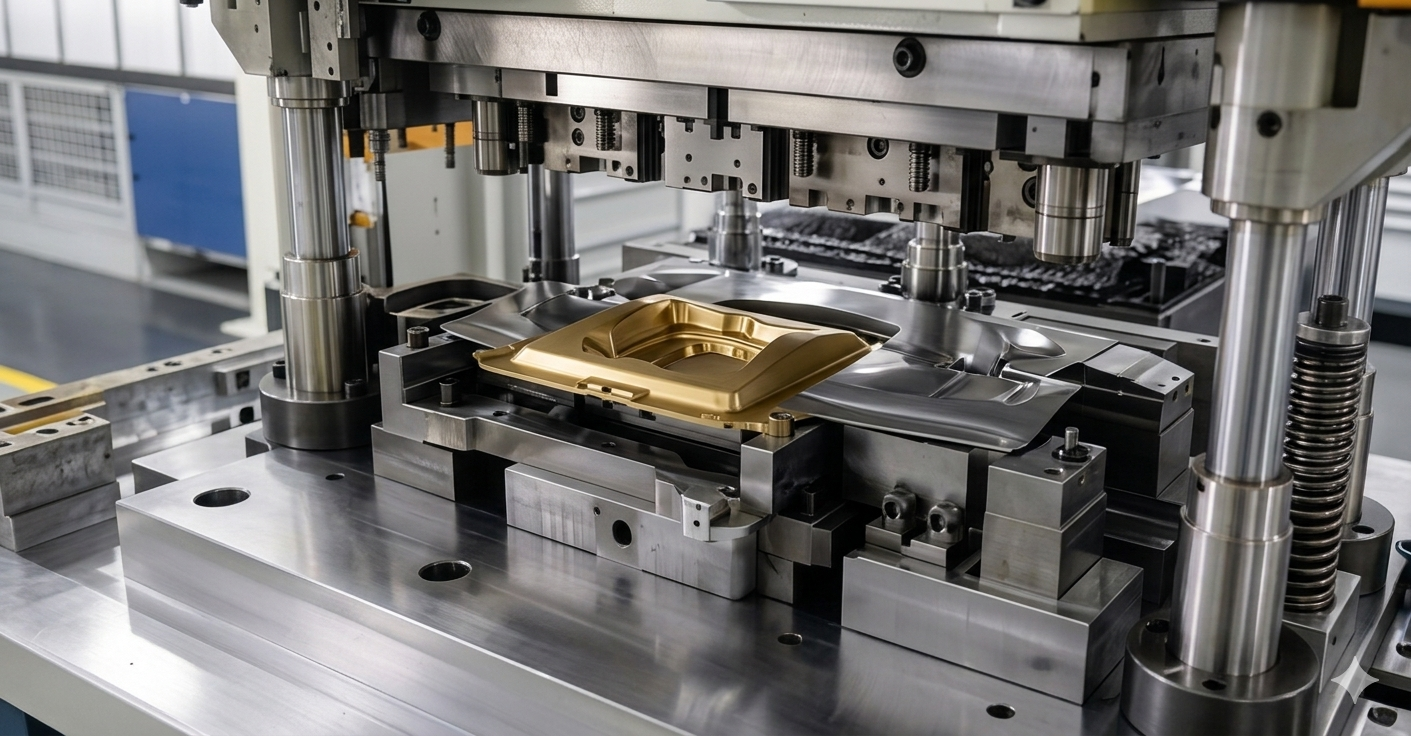
Within a progressive die, many operations such as cutting, punching, forming, and bending can occur on the same line. Therefore, the loads generated are not concentrated at a single point but are distributed across stations.
When performing tonnage calculations, along with total force, the position of the load center must also be considered. Unbalanced load distribution causes wear on press slides and loss of precision. Since high-speed operation is common in progressive systems, press rigidity is of great importance. Minimizing body deflections directly affects product quality.
In deep drawing applications, material is not only cut but also transformed into a specific form. Therefore, the amount of force required differs from standard cutting operations.
In deep drawing operations, blanking force, friction conditions, and material flow must be evaluated together. When insufficient force is used, wrinkles or shape distortion can occur.
In cutting operations, the cutting perimeter, material thickness, and material's cutting strength are the primary determining factors. Equipment selected without proper tonnage calculations can negatively affect production quality.
When the same part is manufactured from different materials, the force values required can change. For example, the forming behavior of high-strength steel and aluminum differ considerably from each other.
As material thickness increases, the resistance generated during cutting and forming also increases. Therefore, engineers focus not only on part geometry but also on the material's mechanical properties when selecting a press. At this point, correctly performed tonnage calculation work is critically important both for production safety and equipment lifespan.
|
Die Type |
Required Force Type |
Critical Point |
|---|---|---|
|
Progressive die |
Distributed force |
Balance is very important |
|
Deep drawing |
High constant force |
Material flow |
|
Cutting die |
Sudden high force |
Cutting perimeter |
Even if incorrect tonnage selection is not immediately apparent, it causes significant costs over time. Erroneous tonnage choice affects production quality, machine and die lifespan.
In presses with insufficient capacity, die elements can be subjected to higher than expected strain. This creates early wear on cutting edges and dimensional deviations. In some cases, parts cannot be fully formed or the cutting operation cannot be completed. As a result, scrap rates increase and production costs rise. Incorrect tonnage selection directly creates negative effects on die lifespan. More frequent maintenance needs and spare part costs become inevitable.
In presses operating above their capacity, the body and mechanical systems can be damaged over time. Deformations can occur in the shaft, bearings, and slide systems. Such problems not only increase maintenance costs but can even cause production line stoppages. Particularly, prolonged undetected overloads cause serious press damage. Loss of body rigidity negatively affects product precision, resulting in quality problems.
For a successful production process, quality die design alone is not sufficient. The die and press must be evaluated together. Therefore, during the project phase, machine capacity, production targets, and material properties should be analyzed in detail.
This is where Kahraman Kalıp comes in, providing technical support to our solution partners by considering production conditions in sheet metal die projects. Our expert teams evaluate the die's working characteristics, production quantity, and equipment specifications together, creating optimum solutions.
Correctly planned press-die compatibility increases both product quality and business efficiency. Thus, unnecessary maintenance costs are reduced while production processes become more sustainable.
For businesses wanting to get maximum return from die investments, not only design but also press performance and force analyses are of critical importance. Correct engineering work done at the beginning of the production process can prevent costs that might arise later. Therefore, the right path for businesses wanting to prevent unnecessary expenses on critical topics such as press selection and tonnage calculation will be Kahraman Kalıp.
Why is tonnage calculation important?
If correct tonnage calculation is not performed, the die can be damaged and production quality declines.
How does press selection affect production?
Production speed, energy consumption, and part quality depend directly on press selection.
Does every press work with every die?
No. Die structure and production force must be compatible.